
08
Sep
Qualcomm 6G Leadership Day – Putting the Steppingstones of 6G
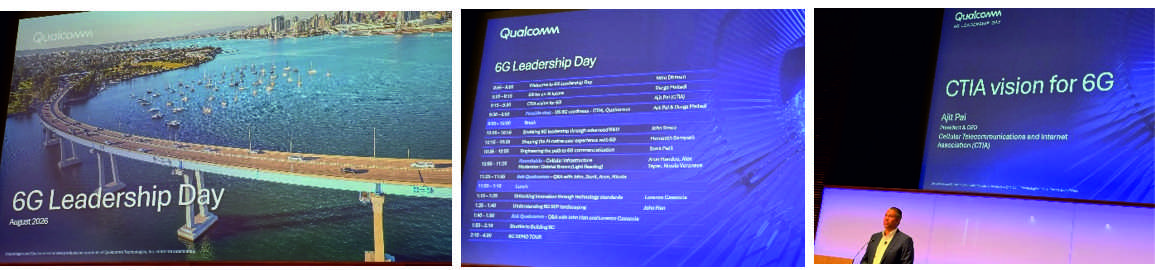
In cellular technology, when Qualcomm talks, the industry pays attention and listens. That is because the company not only talks the talk but also walks the walk by making products that turn the vision into reality. That’s exactly what was on display at Qualcomm’s 6G Leadership Day, on Aug 25, 2026, at its global headquarters in San Diego. The company previewed where 6G is headed, committed to a 6G modem in the second half of 2029, and signaled that its IP licensing approach will likely follow the 5G model.
I got the opportunity to attend the event, listen to the presentations and discussions, speak with Qualcomm’s executives and engineers, and check out interesting live demos. Qualcomm also invited CTIA President and CEO and former FCC chair, Ajit Pai, to deliver the keynote. Mr. Pai is working across the US cellular industry to identify and secure one of the most important ingredients for 6G: spectrum!
Key highlights and main messages:

-
6G will be a confluence of connectivity + compute + sensing
-
Will be AI native and Agent-centric: AI will be infused into every part of the system—radio (AI RAN), device, network, apps, services—with distributed AI compute
-
Will be device-driven, with heavy emphasis on uplink (2-5x edge data rate) – Different from previous generations, where the system was network-driven and downlink-focused
-
Biggest differentiator is “Dynamic QoS”- real-time QoS management for best performance & efficiency – was a vision for previous generations, but is being fully realized in 6G through AI
-
Wide-area sensing is a major “NEW” use case. Most other use cases are enhanced 5G. NTN will be integral to the 6G offering
-
Need for up to 400 MHz wide contiguous mid-band spectrum: 6–8.4 GHz band is a primary target
-
Most fundamental radio technologies, such as modulation, coding, etc., to remain the same as 5G, with performance improved by AI
-
Because of this, Qualcomm believes the IP landscape, be it leadership, licensing framework, competitive positioning, etc., will remain the same as 5G. This means AI enhancements will be more proprietary and for differentiation. No word on licensing fee structure
-
No clarity on licensing “Sensing’ IP as it is implemented on the network (not device)
-
Timelines: First 3GPP spec with 6G will be Release 21, expected to be finalized by early CY2029; First 6G modem by the second half of CY2029
-
Many interesting live demos:
-
Giga MIMO – Transmitter and Receiver system with 1024 antenna elements using 8 GHz
-
3D Sensing (aerial and terrestrial) using terrestrial network (base stations)
-
Many use cases of Dynamic QoS working with Distributed compute – low-latency configuration, in near real-time, when and where needed
-

0 comments